
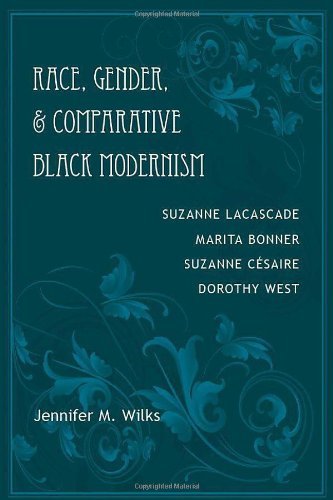
Race, Gender, & Comparative Black Modernism: Suzanne Lacascade, Marita Bonner, Suzanne Cesaire, Dorothy West
Produktdetails
| Artikelnummer | 233428744 | Erscheinungsdatum | 2026/06/27 | Listenpreis | €13.08 | Modellnummer | 233428744 | ||
|---|---|---|---|---|---|---|---|---|---|
| Kategorie | |||||||||
Race, Gender, and Comparative Black Modernism revives and critiques four African American and Francophone Caribbean women writers sometimes overlooked in discussions of early-twentieth-century literature: Guadeloupean Suzanne Lacascade (dates unknown), African American Marita Bonner (1899--1971), Martinican Suzanne Césaire (1913--1966), and African American Dorothy West (1907--1998). Reexamining their most significant work, Jennifer M. Wilks demonstrates how their writing challenges prevailing racial archetypes -- such as the New Negro and the Negritude hero -- of the period from the 1920s to the 1940s, and explores how these writers tapped into modernist currents from expressionism to surrealism to produce progressive treatments of race, gender, and nation that differed from those of currently canonized black writers of the era, the great majority of whom are men.Wilks begins with Lacascade, whom she deems "best known for being unknown," reading Lacascade's novel Claire-Solange, âme africaine (1924) as a protofeminist, proto-Negritude articulation of Caribbean identity. She then examines the fissures left unexplored in New Negro visions of African American community by showing the ways in which Bonner's essays, plays, and short stories highlight issues of economic class. Césaire applied the ideas and techniques of surrealism to the French language, and Wilks reveals how her writings in the journal Tropiques (1941-45) directly and insightfully engage the intellectual influences that informed the work of canonical Negritude. Wilks' close reading of West's The Living Is Easy (1948) provides a retrospective critique of the forces that continued to circumscribe women's lives in the midst of the social and cultural awakening presumably embodied in the New Negro. To show how the black literary tradition has continued to confront the conflation of gender roles with social and literary conventions, Wilks examines these writers alongside the late twentieth-century writings of Maryse Condé and Toni Morrison. Unlike many literary analysts, Wilks does not bring together the four writers based on geography. Lacascade and Césaire came from different Caribbean islands, and though Bonner and West were from the United States, they never crossed paths. In considering this eclectic group of women writers together, Wilks reveals the analytical possibilities opened up by comparing works influenced by multiple intellectual traditions. Read more
Korrektur der Produktinformationen
Wenn Sie Unvollständigkeiten oder Fehler in den Produktinformationen auf dieser Seite bemerken, nutzen Sie bitte das Korrekturformular unten.
KorrekturanfrageKundenbewertungen
Für dieses Produkt liegen derzeit keine schriftlichen Bewertungen vor.